
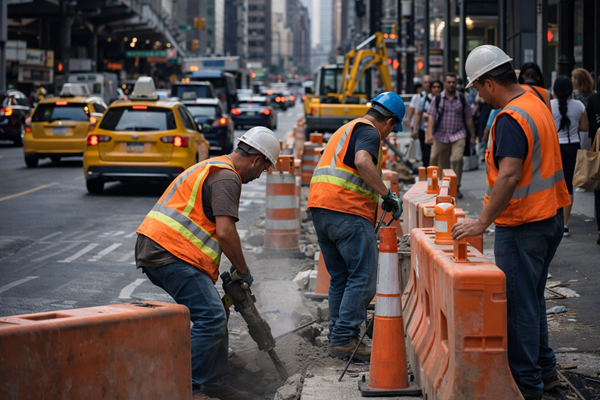
Why Open Construction Sites Put Both Workers and Pedestrians at Risk
Construction in New York City does not happen in controlled, isolated environments. It happens next to moving traffic, crowded sidewalks, bus stops, storefronts, and people going about their day. That combination creates a level of risk that doesn't exist on closed job sites. When something goes wrong, it does not just affect workers. It affects anyone in the area.
Construction work is consistently ranked among the most dangerous jobs, and recent data from New York shows just how serious the risk remains. Dozens of construction workers lose their lives each year. In 2024, more than 50 fatal workplace injuries occurred in construction and extraction in New York, according to a new federal report. That risk only increases when work is performed in active public spaces where exposure is constant, and control is limited.
A laborer working near a Manhattan avenue may be dealing with passing trucks, tight work zones, and limited visibility. A pedestrian standing nearby may have no idea that materials are being hoisted overhead or that equipment is moving behind barriers that are not as secure as they appear. In these environments, even a single mistake or safety failure can lead to serious injuries within seconds.
Why Work Near Traffic Increases The Risk Of Serious Accidents
Construction zones near active roadways introduce hazards that do not exist on interior or fully secured sites. In New York City, this risk is amplified on heavily traveled corridors such as the FDR Drive, the West Side Highway, and the Brooklyn-Queens Expressway, as well as on major routes like Atlantic Avenue and Queens Boulevard. These are high-volume roads where traffic moves quickly, congestion builds without warning, and drivers are often navigating lane shifts or construction detours at the same time.
Workers in these areas are often forced to operate in narrow spaces with vehicles passing just feet away. Drivers may be distracted, speeding, or unfamiliar with temporary traffic patterns, especially in areas where construction changes daily conditions. On roads like the BQE or FDR, where space is already limited, even a small mistake can put workers directly in harm’s way.
At the same time, workers may be focused on their specific task, whether that is guiding equipment, handling materials, or setting up structures. That split attention creates risk. When communication breaks down or a driver fails to react in time, the result is often a high-impact collision involving a worker or piece of equipment.
These incidents are not limited to vehicle strikes. The presence of traffic affects how materials are moved, how equipment is positioned, and how safely a work zone can be maintained. It reduces the margin for error across the entire site, especially in high-traffic areas where there is little room to recover from a mistake.
In dense areas like Manhattan and parts of Brooklyn, construction often takes place within inches of pedestrian traffic, leaving little separation between active work zones and the public.
Common Hazards In Construction Zones Near Public Areas
These cases often involve recurring safety issues that should have been addressed before the work began. When those risks are ignored or underestimated, the likelihood of a serious accident increases.
- Falling Objects: Materials or tools dropped from height due to improper securing or handling.
- Vehicle and Equipment Strikes: Workers or pedestrians struck by trucks, forklifts, or other machinery.
- Inadequate Barriers: Temporary protections that fail to separate the public from active work areas.
- Poor Traffic Control: Lack of proper signage, flagging, or lane management around the site.
- Unstable Work Zones: Uneven surfaces, debris, or poorly maintained pathways that create hazards.
Issues like these point back to one core problem. The site was not properly controlled for the conditions surrounding it.
In many of these incidents, the issue is not a single failure, but a chain of small oversights that combine in a high-risk environment.
How Liability Is Determined In NYC Construction Accidents
New York law provides strong protections for workers and, in many cases, for people injured near construction sites. Labor Law Sections 200, 240, and 241 are often central to these claims, particularly when the accident involves unsafe conditions or failures in site safety.
These laws place responsibility on owners and contractors to maintain safe work environments and protect against hazards such as falling objects and unsafe equipment use. When work is performed near public areas, that responsibility extends to protecting pedestrians as well.
In practice, these cases require a detailed investigation. It is not enough to show that an accident occurred. The case must establish how safety measures failed and which parties were responsible for those failures.
How These Laws Apply in Real-World NYC Construction Accidents
When Traffic Exposure Becomes a Safety Failure
Construction near active roads increases the responsibility to control the environment. When that control breaks down, liability often follows.
When Protection Measures Fall Short
Barriers, signage, and coordination with traffic are not optional. If they fail, the focus shifts to whether the site was properly managed.
When Multiple Parties Share Responsibility
These cases often involve contractors, subcontractors, and property owners. Determining who was responsible for safety is a key part of the claim.
Frequently Asked Questions About NYC Construction Accidents
Who can be held responsible for a construction accident in NYC?
Responsibility may fall on property owners, contractors, or subcontractors, depending on how the site was managed.
Do NYC laws protect pedestrians near construction sites?
Yes. Property owners and contractors must take steps to protect people in public areas near construction work.
What are Labor Law Sections 200, 240, and 241?
These laws address workplace safety, particularly hazards like falling objects and unsafe conditions.
What should I do after a construction accident?
Seek medical care and document the scene if possible. Evidence from the site can be important.
Get A Premier NY Legal Team That Builds Your Case To Win
Insurance companies handling construction accident claims often move quickly to limit what they pay. They may argue the site was safe, shift blame, or treat the incident like it could not have been prevented. That is how strong claims get undervalued from the start.
Keogh Crispi, P.C., takes a different approach. Every case is prepared for trial from day one. That means securing evidence early, documenting site conditions, analyzing safety failures, and working with the right experts to show exactly how the accident happened and why it should have been prevented. When a case is built this way, insurance companies take it seriously.
That approach has led to significant results, including a $6 million recovery in a crane accident case involving serious construction site injuries. Results like that come from preparation, strategy, and a willingness to take cases as far as necessary.
With decades of courtroom experience and a record of high-value outcomes, the focus remains on a single outcome. Full compensation that reflects the actual cost of the injury.
If you were hurt in a construction accident in New York City, contact us to schedule a free consultation to review your case and understand what it will take to move forward.
"Pat Crispi is definitely the kind of tough-as-nails attorney that you want on your side when dealing with insurance companies or anyone else." - Ahmad S., ⭐⭐⭐⭐⭐