
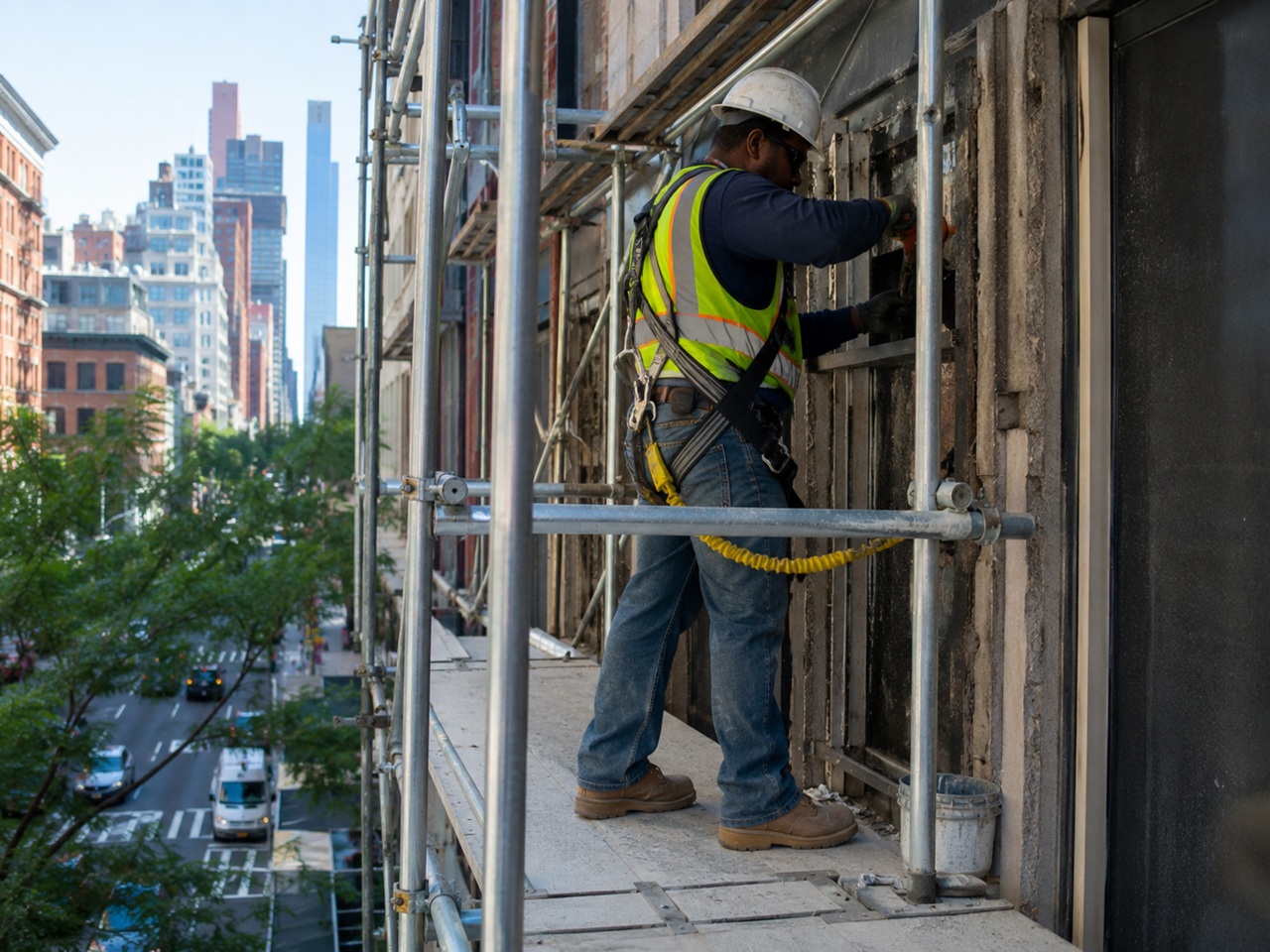
Three New York Labor Laws Can Change What Happens After A Construction Accident
Construction workers in New York City face hazards that can change their lives in seconds. A scaffold can shift, material can fall from an upper floor, machinery can malfunction, or debris can turn a passageway into a dangerous walking surface.
When a serious New York City construction accident happens, workers' compensation may provide medical care and partial lost-wage benefits. But an injured worker may also have a separate claim against a property owner, general contractor, or another responsible party.
That's where New York Labor Law §§ 200, 240(1), and 241(6) become particularly important. Although all three laws are designed to protect workers, they don't impose the same duties, require the same evidence, or apply to the same hazards.
In New York, Keogh Crispi, P.C. has used these laws to hold owners, contractors, and other responsible parties accountable in serious construction injury cases. Understanding the differences can help explain why the details of how an accident occurred matter so much.
Labor Laws 200, 240, And 241(6) Protect Workers In Different Ways
| New York Labor Law | Main Focus | What Often Matters Most |
|---|---|---|
| Labor Law § 200 | General workplace safety and negligence | Who controlled the work, or who created or knew about a dangerous condition |
| Labor Law § 240(1) | Elevation-related hazards | Whether required safety devices provided proper protection and whether a violation caused the injury |
| Labor Law § 241(6) | Specific construction, demolition, and excavation safety rules | Whether an applicable, concrete Industrial Code requirement was violated and caused the injury |
A single accident can support claims under more than one of these laws. The important question isn't which statute most closely resembles what happened. It's what the evidence shows about the hazard, the work being performed, the parties responsible for the site, and the safety rules that applied.
Labor Law 200 Covers Unsafe Conditions And Unsafe Work Practices
New York Labor Law § 200 requires covered workplaces to provide reasonable and adequate protection for workers' health and safety. It largely reflects the traditional negligence duties that owners and contractors can owe at a job site.
But Labor Law 200 cases generally don't all work the same way.
A Dangerous Condition On The Property
Some accidents are caused by physical conditions at the site, such as debris in a passageway, a damaged structure, a slippery surface, poor lighting, or other dangerous conditions.
In those cases, an important question is whether the owner or contractor created the hazard or had actual or constructive notice of it and failed to address it.
For example, Keogh Crispi represented a construction-site security guard who was injured when a damaged gatepost collapsed onto him. We established that the general contractor failed to exercise reasonable care under Labor Law 200 and had constructive notice of the longstanding deterioration. The case resulted in a $225,000 recovery.
The Means And Methods Of The Work
Other Labor Law 200 cases involve how the work itself was being performed rather than a defect in the premises.
When the accident arises from a contractor's methods, equipment, or manner of performing the work, the analysis can turn on whether the defendant had authority to supervise or control the injury-producing activity.
That distinction is important. Simply being the property owner doesn't necessarily establish liability under Labor Law 200 for everything a subcontractor does on the site.
Labor Law 240 Protects Workers From Specific Gravity-Related Risks
Labor Law § 240(1) is commonly called New York's Scaffold Law, but scaffolds are only part of what it covers.
The statute requires owners, contractors, and their agents to provide proper safety devices for covered workers performing certain construction-related activities involving elevation risks. Those devices can include scaffolds, hoists, ladders, slings, hangers, blocks, pulleys, braces, ropes, and other protective equipment.
That can make § 240(1) especially important after falls from height on NYC construction sites. It can also apply when an object falls because it wasn't properly secured against an elevation-related risk.
Our NYC Scaffold Law attorneys investigate what safety equipment was available, how it was installed, whether it was adequate for the task, and why it failed to protect the worker.
Labor Law 240 Is Strict, But A Fall Does Not Automatically Create Liability
Labor Law 240 imposes a strict, nondelegable duty on covered owners and contractors. That means they generally can't escape their statutory responsibility simply by assigning safety obligations to a subcontractor.
But describing the law as "absolute liability" can create the wrong impression.
An injured worker must still establish that Labor Law 240 applied, that the required protection was absent or inadequate, and that the statutory violation caused the injury. The fact that a worker fell from a ladder or scaffold doesn't automatically establish a violation.
There is also an important distinction between comparative negligence and sole proximate cause.
If inadequate safety equipment contributed to a covered accident, an owner's or contractor's Labor Law 240 liability generally isn't reduced merely because the worker was also careless.
But a defendant can avoid liability when adequate safety devices were available, the worker knew they were expected to use them, chose not to use them without good reason, and that choice was the sole cause of the accident.
That's why the investigation needs to determine what equipment was actually available rather than simply accepting a later claim that the worker "should have been more careful."
Falling Objects Can Also Trigger Labor Law 240
Labor Law 240 isn't limited to workers who physically fall.
A worker can also have a § 240(1) claim after being struck by an object that should have been secured or required protection because of an elevation-related risk.
These falling-object construction accidents can involve building materials, tools, structural components, concrete, bricks, or equipment moving between different elevations.
Keogh Crispi represented a construction mason who was working from a suspended scaffold and had to climb over a parapet wall to reach the roof. His safety line became tangled, and gravity left him suspended between the scaffold and building. We held the responsible party accountable under Labor Law § 240(1) and an applicable Industrial Code provision and recovered $2.25 million.
That result depended on the circumstances of that particular case. Prior results don't guarantee a similar outcome.
Labor Law 241(6) Depends On A Specific Industrial Code Rule
Labor Law § 241 addresses safety during construction, excavation, and demolition work. Subdivision 6 requires owners, contractors, and their agents to comply with safety rules adopted by the New York Commissioner of Labor.
For an injured worker pursuing a § 241(6) claim, it generally isn't enough to point to a broad statement that a work area should have been "safe."
The claim needs to be tied to an applicable provision of the New York Industrial Code that sets out a concrete safety requirement. Depending on the accident, those regulations can address issues such as:
- Protection from slipping and tripping hazards;
- Guarding floor openings and hazardous areas;
- Scaffolds and elevated work platforms;
- Protection from falling materials;
- Excavation safety;
- Electrical hazards;
- Working near machinery and equipment; and
- Safe passageways and work areas.
The rule also has to apply to the work and circumstances that actually caused the injury.
A Labor Law 241(6) Violation Does Not Work Exactly Like Labor Law 240
Both § 240(1) and § 241(6) impose important nondelegable duties, but the liability analysis isn't identical.
A qualifying Industrial Code violation under § 241(6) can provide evidence of negligence, but it doesn't automatically resolve every liability question. Causation still matters, and comparative negligence can be considered.
Keogh Crispi represented a construction laborer who was struck by unsecured bricks that fell from a building bulkhead one story above him. The impact knocked him through an unsafe opening in platform planking and onto the scaffold below.
We established violations of both Labor Law § 240(1) and § 241(6) and obtained a $750,000 recovery.
That case is a good example of why the same construction accident can implicate more than one Labor Law provision.
The Three Laws Can Overlap In One Construction Accident
Imagine a worker falls through an opening on an elevated construction platform.
Labor Law 240 may apply if the worker wasn't provided adequate protection from the elevation-related hazard. Labor Law 241(6) may also apply if the platform or opening violated a specific requirement under the Industrial Code.
If the accident also resulted from a dangerous condition that an owner or contractor created or knew about, Labor Law 200 might become relevant as well.
Another accident could produce a completely different combination. A worker who trips over construction debris at ground level may have a strong Labor Law 200 or 241(6) claim without having any viable Labor Law 240 claim at all.
The point isn't to stack statutes onto every case. It's to identify the legal duties that actually correspond to the way the accident happened.
Labor Laws 240 And 241(6) Have An Important Homeowner Exception
Not every property owner is treated the same under these statutes.
Both Labor Law § 240 and § 241 generally exempt owners of one- and two-family dwellings who contract for construction work but don't direct or control how that work is performed.
The statutes don't grant the same exemption to the general contractor or another party simply because the project involves a one- or two-family home.
The homeowner's own involvement can also matter. New York courts look at whether the owner actually supervised the method and manner of the work, not merely whether the homeowner selected materials, discussed what they wanted built, or checked on the project's progress.
That exception is one reason ownership records and the actual relationships among everyone on the project have to be investigated before deciding who can be sued.
Architects And Engineers Are Not Automatically Labor Law Defendants
The statutes also contain protections for architects, professional engineers, and landscape architects who aren't directing or controlling construction work outside their planning and design functions.
That doesn't mean those professionals can never be liable for an injury. Other legal claims may exist depending on their own conduct.
But an architect isn't automatically liable under Labor Law 240 or 241(6) simply because their plans were used on the project. The investigation must determine whether they had the authority or involvement required by applicable law.
Your Direct Employer And A Third-Party Labor Law Claim Are Different Issues
Most injured employees can't bring an ordinary personal injury lawsuit against their direct employer because New York workers' compensation generally provides the exclusive remedy for an on-the-job injury.
Workers' compensation can provide medical care and a portion of lost wages. A separate third-party construction accident claim, when available, can seek damages that workers' compensation doesn't provide in the same way, including pain and suffering and other losses.
Potential third-party defendants can include:
- Property Owners: Owners can have statutory responsibilities under Labor Laws 240 and 241(6), subject to applicable exceptions.
- General Contractors: General contractors are frequent Labor Law defendants because of the statutory duties imposed on them.
- Statutory Agents: Another company with sufficient authority to perform the relevant work may qualify as an owner's or contractor's agent under the Labor Law.
- Subcontractors: Depending on their control over the work and their conduct, subcontractors may be liable under Labor Law 200 as statutory agents or under other negligence principles.
- Equipment Manufacturers: When defective machinery or safety equipment causes an accident, a separate product liability claim may be possible.
Determining who can be sued after an NYC construction accident usually requires reviewing the construction contracts, ownership records, subcontractor agreements, safety responsibilities, and actual control exercised at the job site.
Three Labor Laws Require Three Different Evidence Strategies
The law matters, but construction cases are usually won or lost on evidence showing how the law applies to what actually happened.
Depending on the accident, our investigation may seek:
- Construction contracts and subcontracts;
- Daily site and safety logs;
- Incident reports;
- Photographs and video of the accident area;
- Scaffold, ladder, harness, and equipment records;
- New York City Department of Buildings records;
- OSHA inspection and citation information;
- Training records;
- Applicable Industrial Code provisions;
- Witness testimony;
- Site plans and drawings; and
- Records showing who supervised or controlled the work.
An active construction site can change quickly after an accident. Materials get moved, openings are covered, scaffolds are dismantled, and defective equipment can be repaired or replaced. Taking the right steps after a construction accident can help preserve evidence before the site changes significantly.
Our Construction Results Show Why The Correct Labor Law Matters
Keogh Crispi has handled construction cases involving each of these legal theories. Our construction accident results include:
- $6 Million for Three Workers Injured in a Crane Collapse: Our investigation found violations, including violations of Labor Laws 240 and 241, as well as OSHA safety regulations.
- $2.25 Million for a Construction Mason: We held the responsible party accountable under Labor Law § 240(1) and an applicable Industrial Code provision after an accident involving a suspended scaffold.
- $750,000 for a Construction Laborer: The worker was struck by unsecured bricks and fell through unsafe platform planking. We established violations of Labor Laws 240(1) and 241(6).
- $225,000 for a Construction Site Security Guard: We established a Labor Law 200 violation and constructive notice after a defective gatepost collapsed onto our client.
Those cases involved different hazards and different legal theories, which is exactly why a construction accident shouldn't be evaluated under only one statute. Prior results don't guarantee a similar outcome in another case.
Knowing Which Labor Law Applies Can Change The Entire Case
Labor Laws 200, 240, and 241(6) are all designed to protect workers, but they answer different questions. Labor Law 200 focuses heavily on negligence, dangerous conditions, and control over the work. Labor Law 240 targets specific elevation-related hazards and inadequate safety devices. Labor Law 241(6) turns on concrete requirements in New York's Industrial Code.
Our NYC construction accident attorneys investigate all of those possibilities rather than assuming the most familiar statute is automatically the right one. We review the accident scene, contracts, safety equipment, Industrial Code requirements, site records, and the authority each company had over the work.
Attorney Pat James Crispi has built a substantial record representing workers hurt on New York construction sites. If you've suffered a serious construction injury, contact us for a free consultation. We work on a contingency fee basis, so you don't pay us an attorney's fee unless we recover compensation for you.
"I met Mr. Pat Crispi through a coworker who had a construction accident. I as well had a construction accident. Mr. Crispi was extremely pleasant and sympathetic to my needs. He got me the results I never expected... If you're looking for the right attorney to get the results that you are looking for call him. I'm very pleased to recommend him to anyone, anytime." - Marc Summa, ⭐⭐⭐⭐⭐